


The Economic Impact of the University of Virginia
This study examines the statewide and regional economic impacts of UVA, as well as the impact of major University division and spending component based on FY2024 data. The University of Virginia contributes significantly to Virginia’s economy through its operational spending, employment, capital investments, and the expenditures of students and visitors. In FY2024, UVA—including its Academic Division, Health System, and UVA Wise—employed over 30,900 individuals and generated $6.83 billion in direct expenditures. These expenditures include compensation, procurement, capital projects made by UVA, and the spending of its students and visitors.
This report provides a holistic examination of the economic contributions of the University of Virginia to the Commonwealth of Virginia and its regions. This report is intended to provide a factual and structured account of UVA’s economic role in Virginia, serving as a resource for
policymakers, institutional leaders, and community stakeholders. It evaluates both the direct financial activity associated with university operations and the broader economic and social impacts. The analysis uses input-output modeling (IMPLAN) to estimate the effects of university-related spending across four categories: operations, capital investment, student expenditures, and visitor spending. These estimates include direct, indirect, and induced impacts on employment, labor income, value added, output, and state and local government tax revenues. It also examines a broader set of economic and social benefits that result from the presence of the university, including human capital and talent development, innovation and entrepreneurship, health care quality and access, and economic development and community engagement using information and statistics drawn from a variety of sources.
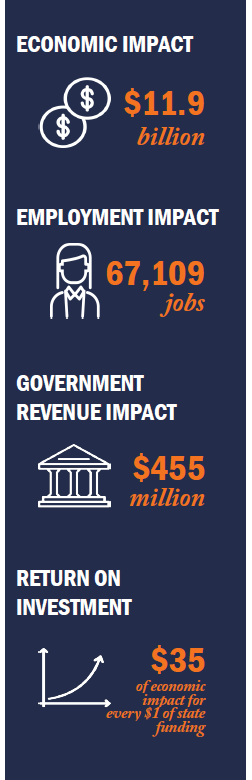
The report finds that the total economic impact of UVA across the Commonwealth was estimated at $11.9 billion in output (the most commonly recognized measure of economic impact), supporting 67,109 jobs (representing one in eighty-five state jobs), and generating $7.3 billion in value added (a measure comparable to gross domestic product) and $5.5 billion in labor income. The university’s activities also produced $191 million in local tax revenue and $264 million in state tax revenue, a total of $455 million in government tax revenue.
The largest share of this impact was concentrated in the Thomas Jefferson Planning District, home to UVA’s main campus, or “Grounds,” which accounted for nearly 75% of total employment and output. UVA’s employment impact represents three out of every eleven jobs in the region. UVA Wise contributed to economic activity in Southwest Virginia, accounting for one in every 72 jobs in the LENOWISCO and Cumberland Plateau Planning Districts. UVA’s operations elsewhere in the state added further employment and revenue through supply chain and service linkages.
Appendices are provided at the end that include technical documentation on methodology data preparation, and definitions used in the analysis.