


Municipal Secession and Transfer Incentives in Brazil
Brazil offers a pertinent case for exploring strategic municipal secession. As a large, decentralized developing country, its municipalities hold substantial administrative, fiscal, and political authority and are responsible for a wide range of public services (Arretche 2000). In federal systems, the creation of new subnational units is often justified by the pursuit of improved proximity, political representation, and service delivery (Steiner 2003). However, when transfer formulas remain rigid or unresponsive to territorial and demographic shifts, new jurisdictions can arise not from administrative necessity but from strategic behavior aimed at capturing a greater share of public resources (Lago et al. 2024). Such conduct can lead to inefficient institutional fragmentation, particularly in countries with unequal and decentralized structures and limited oversight capacity (Fitrani et al. 2005; Dougherty et al. 2024).
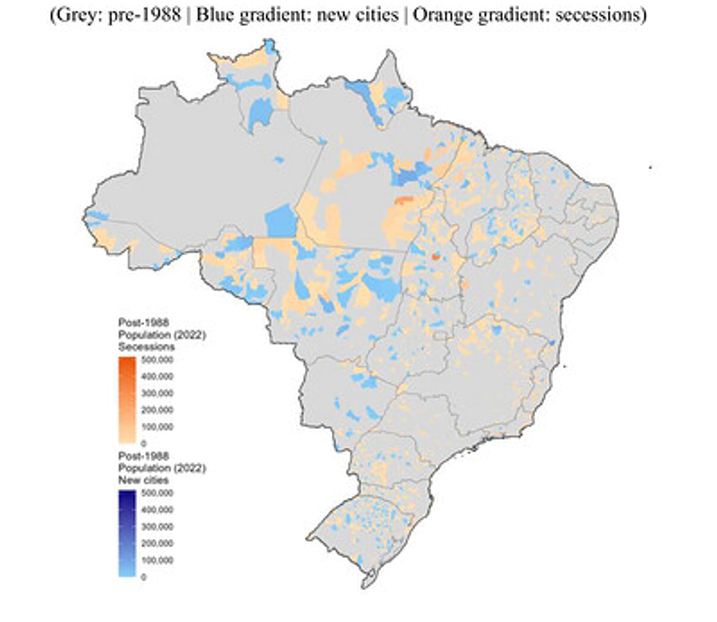
The scale and persistence of municipal fragmentation make reassessing the fiscal advantages and long-term governance effects a relevant policy topic. This article examines the role of the Municipal Participation Fund (FPM) in this process. The FPM is the main channel of unconditional federal transfers to municipalities and is distributed from a fixed pool of resources. Its allocation rules, therefore, create a zero-sum environment in which the creation of new jurisdictions alters the distribution of funds across all municipalities. Pressures for new municipalities remain significant, with more than 800 proposals currently under consideration in state legislatures.
We analyze whether the design of the FPM generates distributive effects and fiscal incentives consistent with two related phenomena. First, rent-seeking, whereby fragmentation or statistical adjustments increase access to transfers (Tollison 2004). Second, the flypaper effect, in which transferred revenues increase public spending more than equivalent rises in own-source revenues, particularly on administrative expenditures (Hines and Thaler 1995). While typically studied separately, we integrate these mechanisms in the context of post-1988 municipal creation and focus on the fiscal consequences of fragmentation under the FPM framework rather than on its political determinants.
By shedding light on the Brazilian empirical context, our goal is to inform policy debates on the fiscal and institutional implications of establishing new municipalities within decentralized systems.
Mota, T. de O., J. Ferreira, and R. C. Gomes. 2026. “ Municipal Secession and Transfer Incentives in Brazil.” Financial Accountability & Management. https://doi.org/10.1111/faam.70040