


Inflation in the EU: how sectoral price shocks ripple domestically and across borders in core and periphery countries
The return of inflation in Western economies has reignited the debate over its causes, bringing sector-specific shocks and supply chain bottlenecks to the forefront. Building on inflation studies using the Leontief price model, we develop a method to measure EU member states’ vulnerability to sectoral price shocks. Using international input–output data, we identify which sectors have the greatest impact on overall inflation and analyze how price shocks spread across borders.
Our findings reveal two critical asymmetries. First, peripheral countries are more exposed to shocks originating in the EU core than vice versa. Second, all EU member states are considerably exposed to price shocks originating from non-EU countries, namely Russia and China. These strategic dependencies pose challenges for price stability and require targeted industrial policy interventions going beyond conventional monetary policy.
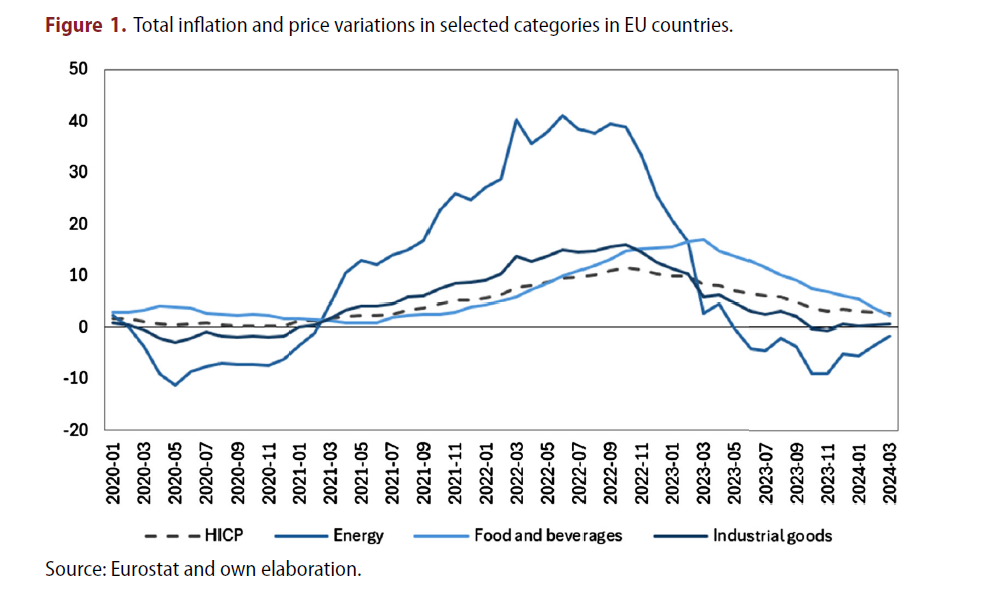
In the context of weaponized interdependencies and as inflation becomes a key economic policy concern, understanding critical sectors’ role in spreading price shocks becomes crucial for appropriately designing policies. Yet, while rather detailed evidence has been provided on the role of critical sectors contributing to the spread of inflation in the US, further research is needed regarding the EU case. The latter is particularly important for at least three reasons. First, the Russia-Ukraine war exposed the strong import dependence of Europe concerning both energy goods as well as energy-related technologies. Second, the EU is characterized by strong internal asymmetries, also regarding the degree of vulnerability of member states vis-à-vis energy, supply chain, and, hence, inflationary shocks. Third, the trade war unleashed by the new US administration could further complicate the EU’s position, increasing the likelihood of further inflationary crises.
The goal of this paper is to fill this literature gap by providing two key contributions. First, identifying the main sectoral drivers of inflation in EU countries, as well as (i) the underlying reasons for the relevance of such sectors, and (ii) the channels through which price shocks are transmitted to the rest of the economy. Second, highlighting heterogeneities and interdependencies between the EU’s core and peripheral areas.
To cite this article: Vicente Ferreira, João Pedro Ferreira, Dario Guarascio & Francesco Zezza (02 Jun 2026): Inflation in the EU: how sectoral price shocks ripple domestically and across borders in core and periphery countries, Economic Systems Research, DOI:10.1080/09535314.2026.2656903
To link to this article: https://doi.org/10.1080/09535314.2026.2656903