


Election Consolidation and Scheduling in the Commonwealth
This report on Election Consolidation and Scheduling in the Commonwealth prepared for the Virginia General Assembly’s Joint Subcommittee to Study the Consolidation and Scheduling of General Elections in Virginia (“the Joint Subcommittee”) examines these key questions:
- Does the Joint Subcommittee recommend consolidating statewide and federal elections?
- If so, which consolidation option does it choose?
- What are the next steps in terms of research and Joint Subcommittee action to further develop an
implementation plan for the identified choice(s)? - If the Joint Subcommittee recommends consolidating statewide and federal elections, does it also recommend aligning local elections with the
federal election calendar? - If so, does it recommend consolidating the elections of local constitutional officers (e.g. the Commonwealth’s attorney, clerk of the circuit
court, treasurer) or all locally elected officials (including constitutional officers)? - If the Joint Subcommittee recommends consolidation, does it also want to recommend changing the current budget cycle?
To address these questions, UVA examined Virginia's election history, researched election consolidation in the United States, compared Virginia to similar states, and conducted stakeholder surveys and interviews (via the Center for Survey Research). Key findings from the latter show that
Overall, the majority of Virginians surveyed support election consolidation. High levels of support are reported comparably across Republican and
Democratic respondents.Image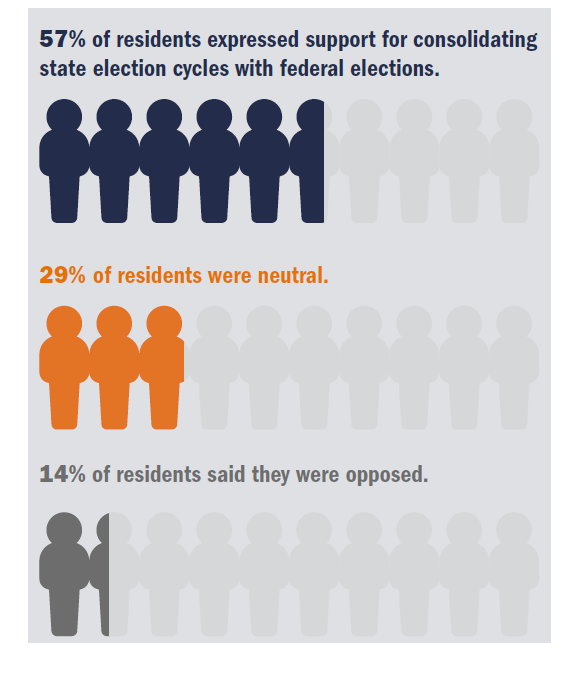
- A bipartisan majority consider the leading potential benefits of consolidated elections to be the increased convenience for voters and expected greater turnout for state elections, especially among those who face barriers to regularly voting.
- A minority of respondents express concerns, however, that consolidating elections could overwhelm voters with the number of ballot measures at one time and could increase the risk that national races would dilute the focus and attention on state and local issues.
- Self-reports of likelihood to vote increase overall under consolidated elections, particularly among younger respondents, individuals who work fulltime, and those with children. However, based on self-reports, voting behaviors are not expected to change for those who are the least politically engaged.
The University of Virginia's Karsh Institute of Democracy prepared this report in partnership with the Weldon Cooper Center for Public Service's Center for Survey Research, the College of Arts & Science's Department of Politics, and the Law School's State and Local Government Policy Clinic.