


LEADership Leap
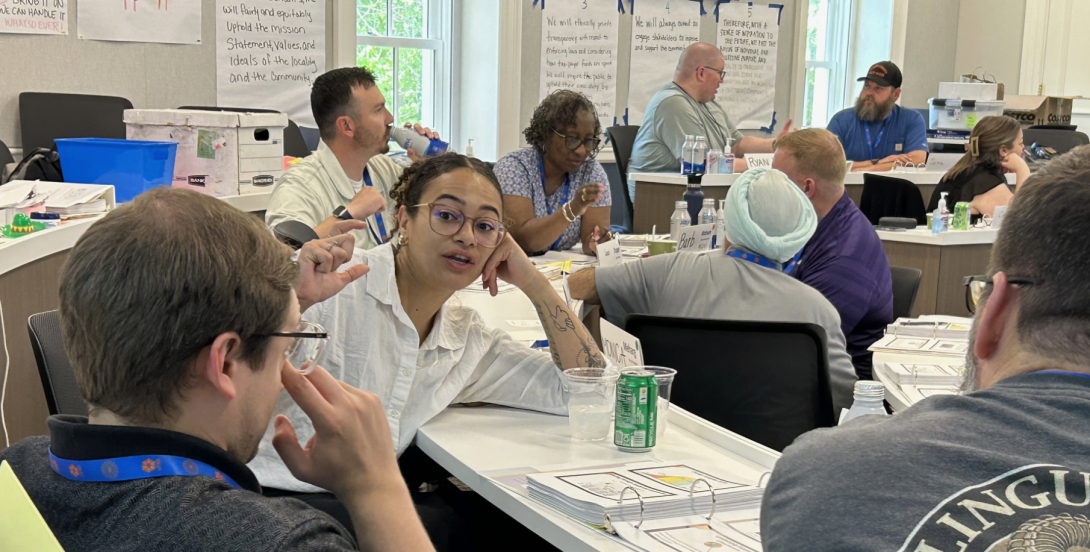
Styled after LEAD, and utilizing the typical teams for small group work, LEADership Leap is for those who are first time supervisors or rising stars in your organization.
Again, and again our friends in local government related that one of the toughest organizational challenges is preparing their employees for supervisory roles. Still relying on the principles that make our programs special - context, environment, and connection, we created the curriculum to meet this challenge.
2026 Program Dates
Saturday to Friday, September 26 – October 2, 2026
- Fees & Cancellation Policy
The LEAP fee is $5,500 for 2025. The fee includes instruction, lodging, most meals, and materials. A 10% discount is available for members of the Virginia Institute of Government. Payment in full is due 60 days before the start of the program.
Information You Will Receive in Advance of Program
With your LEAP welcome email, we will send you:
- Materials to help you plan your visit, including hotel and parking information; details on getting to Charlottesville whether it is by plane, train, bus or car; and recommendations for places to visit while you are here.
- Program schedule that includes meeting times and places.
- Additional information about meals, required evening activities, and other details, like meeting etiquette, attire, as well as recommendations for getting the most out of the LEAP experience.
- Pre-work to do in advance to better prepare for your experience.
Cancellation Policy
From the time that your participation has been confirmed via email, if you cancel more than two weeks in advance of the program start date, you will forfeit half of the tuition cost. Transferring to an alternate date does not release you from this obligation. However, to avoid any penalties, acceptable substitutions may be made with our advance approval. No refunds can be made within two weeks of the start date. We greatly appreciate notification ASAP of any need to cancel.
- Ideal Leap Participant
Primary Responsibility: Leading people day-to-day with credibility and trust.
Leap is designed for individuals who are stepping into or preparing for people-leadership roles and need a strong foundation in modern supervisory skills. It is ideally suited for early-career managers, first-time supervisors, and high-potential employees who are being developed for future leadership responsibilities. Leap also supports front-line supervisors and mid-level managers who have been leading teams without access to formal leadership training and now need a structured, comprehensive approach to building their capabilities.
Participants will strengthen core competencies such as communication, delegation, performance management, conflict resolution, and team motivation. They will also explore the mindset shifts required to move from individual contributor to effective leader—developing confidence, emotional intelligence, and the ability to foster trust and accountability. By combining practical tools with reflective learning, Leap equips emerging leaders to navigate real-world challenges, support team success, and contribute to a positive organizational culture.
Ultimately, Leap prepares rising leaders at all levels to lead with clarity, purpose, and effectiveness—ensuring they are ready to manage people, influence outcomes, and support the mission of their organization.
Apply Today
Course Descriptions
- Problem-Solving Through Creative Collaboration
Description:
This program introduces creative problem solving as a structured and repeatable process that teams can use to generate innovative solutions to complex challenges. Participants learn the five-step creative problem-solving framework and practice techniques such as divergent and convergent thinking, mind-mapping, and the use of parallel teams to expand ideas and refine them into practical solutions. The session also explores how psychological safety, collaboration, and intentional facilitation support group creativity and helps participants apply these methods to real workplace problems.
Learning Outcomes:
Participants will be able to:
- Explain creativity as a structured, repeatable process, rather than solely an individual trait, and describe how groups can intentionally generate innovative solutions.
- Describe the five-step creative problem-solving process, including how each step contributes to effective problem definition and solution development.
- Apply divergent and convergent thinking techniques to expand possibilities and then focus ideas into actionable solutions.
- Use mind-mapping as an idea-generation tool to surface connections, patterns, and novel approaches to complex problems.
- Explain the purpose and value of parallel teams, particularly in increasing creativity, reducing groupthink, and improving solution quality.
- Participate effectively in a facilitated creative process, practicing collaboration, experimentation, and open inquiry.
- Evaluate ideas using structured criteria, ensuring creativity is balanced with feasibility and alignment to goals.
- Identify conditions that support group creativity, including psychological safety, curiosity, and intentional facilitation.
- Apply creative problem-solving techniques to real workplace challenges, identifying opportunities to use these methods in their own teams or organizations.
- Leadership in Constitutional Culture
Description:
This program provides an overview of how local government functions and the leadership skills needed to serve effectively within it. Participants explore the purpose and role of local government, the relationships among staff, departments, elected officials, boards and commissions, and community partners. How staff support the priorities and needs of elected leadership is also studied. The session also examines the distinction between leadership and management and highlights the individual, team, organizational, and community-level skills required to lead successfully in the public sector.
Learning Outcomes:
- Participants will increase their understanding of local government’s legal structure, purpose and role
- Participants will increase their understanding of the connection between staff, local government departments, elected officials, boards, and commissions, and other partners
- Participants will increase their understanding of elected official motivation and needs as related to staff’s role in supporting them
- Participants will increase their understanding of the difference between leadership and management
- Participants will increase their understanding of the individual, team, organization, and community skills required to lead
- Unlocking your Strengths
Description:
Strengths-Based Leadership is the leadership practice of investing in your strengths. This workshop focuses on identifying top strengths, developing them, and applying them to boost productivity, engagement, and team collaboration.
Learning Outcomes:
- Participants will learn about strengths-based leadership.
- Participants will examine the results of their StrengthsFinder assessments.
- Participants will understand and apply strengths-based leadership.
- Presence, Public Speaking, and Presentation Skills
Description:
Skilled actors know how to have their audience pay attention to them for long periods of time and make their audience remember their words for extended periods of time. The instructor will share techniques that actors use in engaging their audiences and demonstrates how these techniques can be adapted to almost any business communication situation.
Learning Outcomes:
- Participants will learn about public speaking and its importance for leadership
- Participants will learn how to:
- Avoid nerves and stage fright before you begin.
- Grab your audience with your entrance.
- Utilize your space more effectively to keep your audience watching you.
- Utilize body language and non-verbal techniques to keep your audience engaged
- Demonstrate improved eye contact with your audience.
- Speak with better diction, inflection, tonality, and vocal variety.
- Speak for extended times without vocal fatigue.
- Speak more effectively on the telephone
- Navigating New Roles and Responsibilities
Description:
This program introduces the core principles of Situational Leadership and how leaders can adapt their approach to meet the needs of their team. Participants learn how to assess employee competence and commitment, diagnose development levels, and balance task direction with relationship support. Through practical application of the Situational Leadership model, leaders develop the skills to provide the appropriate level of guidance, coaching, and encouragement to help individuals and teams succeed.
Learning Outcomes:
- Participants will explore and apply the Core Principles of Situational Leadership
- Adaptability is key: Leaders must be flexible and willing to change their behavior rather than adhering to a single leadership style.
- Follower-centric: The focus is on the needs of the team members, specifically their ability and willingness to perform a task.
- Balance task and relationship: Leaders need to balance directing and providing instructions (task behavior) with offering encouragement and support (relationship behavior
- Identify competence (knowledge) and commitment (willingness): To successfully match leaders must determine levels of competence and commitment.
- Participants will practice a model to help you provide appropriate direction and support.
- Participants will explore and apply the Core Principles of Situational Leadership
- Managing and Leading Different Personalities, Generations, and Expectations
Description:
This program prepares emerging supervisors to navigate the relationship changes that occur when stepping into leadership roles. Participants explore how relationships evolve when transitioning from peer to supervisor, learn strategies for building trust while maintaining appropriate boundaries, and examine how perceptions and assumptions influence workplace dynamics. The session also provides practical approaches for setting clear expectations with individuals and teams to support effective supervision and strong working relationships.
Learning Outcomes:
- Participants will learn about managing relationships with their team, co-workers, managers, and staff as they take on more supervisory responsibility
- Participants will learn and apply strategies to build relationships with staff along with pitfalls to avoid
- How relationships must change when promoted, especially peer to supervisor
- Setting appropriate boundaries
- Participants will understand perceptions of self and assumptions of others (exercise to share what assumptions the participants have made when someone has been promoted)
- Participants will practice setting expectations for teams and individuals
- Giving and Receiving Feedback
Description:
This program develops leaders’ ability to give clear, constructive, and strengths-based feedback that supports individual growth and team performance. Participants learn when and how to deliver effective feedback, including how to navigate challenging conversations with confidence and respect. Using a structured feedback model, leaders practice skills that leverage individual strengths, reinforce positive behaviors, and address performance concerns in a solution-focused way, preparing them for real-world feedback conversations.
Learning Outcomes:
- Participants will understand what effective feedback is, when it should be given, and best practices for giving feedback and handling all types of feedback conversations, including “challenging” conversations
- Participants will be able to utilize a Strengths-Based approach to feedback that recognizes how individual “Strengths” impacts feedback
- Participants will be able to use feedback to leverage natural talents
- Participants will be able to use the feedback model (presented in class) and its related behaviors and skills as a proven method to give continuous constructive feedback
- Building Accountability and Trust while Developing Others
Description:
This program focuses on developing leaders at every level while achieving results through effective performance management. Participants learn how to engage and develop employees through clear expectations, coaching conversations, and purposeful one-on-one meetings. Using practical tools such as the GROW model, leaders practice strategies for building strong relationships, strengthening accountability, and supporting continuous growth and performance.
Learning Outcomes:
- Participants will explore how and why to create leaders at every level
- Participants will explore and practice how to get results while developing others and enhancing engagement through effective performance management
- Participants will learn techniques for building relationships and creating accountability through effective one-on-one meetings
- Participants will practice skills for setting expectations and managing performance using the GROW model
- Foundations of Emotional Intelligence
Description:
This program introduces the foundations of emotional intelligence and its importance for effective leadership and healthy workplace relationships. Participants explore the key components of emotional intelligence—self-awareness, self-management, social awareness, and relationship management—and practice techniques for emotional regulation and reflection.
Learning Outcomes:
- Participants will learn about emotional intelligence and why building it is important for individuals, teams, and organizations
- Participants will learn and practice emotional regulation
- Participants will gain an understanding of self-awareness and self-management with exercises to improve both
- Participants will gain an understanding of social awareness and relationship management with exercises to improve both
- Participants will learn about the connection between vulnerability and emotional intelligence
- Conflict Styles
Description:
Fear of conflict is one of Lencioni’s “5 Disfunctions of Teams” that holds back team performance. Healthy conflict can be an engine for innovation in organizations. The session uses the TKI instrument to identify default conflict styles and understand the strengths and weaknesses of each style. Participants can practice and apply the skills of conflict management through discussion and case studies.
Learning Outcomes:
Participants will be able to:
- Apply the five conflict management approaches to navigate complex interpersonal and organizational challenges in a public-sector context.
- Assess their personal conflict style and understand how it influences team culture, trust, and effectiveness.
- Diagnose conflict situations by considering mission impact, stakeholder needs, and organizational dynamics.
- Demonstrate leadership behaviors that promote respectful, productive dialogue—even in high-stakes or high-emotion environments.
- Leverage conflict as a tool to strengthen decision-making, surface diverse perspectives, and improve outcomes for the communities they serve.
- Establish clear team norms and expectations that foster psychological safety, accountability, and constructive conflict.
- Project Management Essentials
Description:
This program equips leaders with practical tools for setting goals aligned with organizational priorities and effectively planning work to achieve them. Participants learn how to scope projects by developing work plans, allocating resources, and assessing team capacity. The session also introduces project management best practices and tools, including the RACI matrix, to clarify roles, strengthen accountability, and support successful project execution.
Learning Outcomes:
- Participants will learn how to set goals in alignment with the organization
- Participants will learn more about scoping to include:
- Developing work plans
- Allocating resources
- Assessing employee capacity
- Participants will learn best practices and tools for project management (RACI Matrix)
- Influencing without Formal Authority
Description:
This program explores how leaders can effectively influence others without relying on positional authority. Participants learn the difference between positional power and relational influence and why influence is essential in collaborative, matrixed, and public-sector environments. The session provides practical strategies for building trust, identifying key stakeholders, and tailoring influence approaches using data, stories, and shared goals. Participants also practice influencing peers, supervisors, and external partners in ways that are ethical, credible, and aligned with organizational priorities.
Learning Outcomes:
- Participants will be able to distinguish between positional power and relational influence
- Participants will recognize why influence is essential in matrixed, collaborative, and public-sector environments
- Participants will learn to leverage trust, consistency, and reliability to build influence over time
- Participants will be able to identify key stakeholders and decision-makers
- Participants will learn to adapt influence strategies based on others’ priorities, constraints, and values
- Participants will learn to use data, stories, and shared goals to strengthen persuasive messages
- Participants will be able to avoid manipulation while still advocating effectively for ideas and outcomes
- Participants will practice influencing peers, supervisors, and external partners