


A Typology of Livable Communities and Older Adults’ Health in the U.S.
Neighborhoods with high-quality built environments and social environments are associated with older adults’ well-being. However, research on the complex interplay of neighborhood types and health outcomes is limited, as is the role of functional limitations. This study aims to:
- identify neighborhood types,
- explore the association of neighborhood type and older adults’ health, and
- assess whether functional status affects this association.
We merged data from the 2017 AARP Age-Friendly Communities Surveys and the Livability Index. Our sample included 3211 adults aged 65 and older; the majority (59%) were female. Participants identified as non-Hispanic White (81%), Hispanic (8%), Black (6%), and a member of another racial/ethnic group (2%).
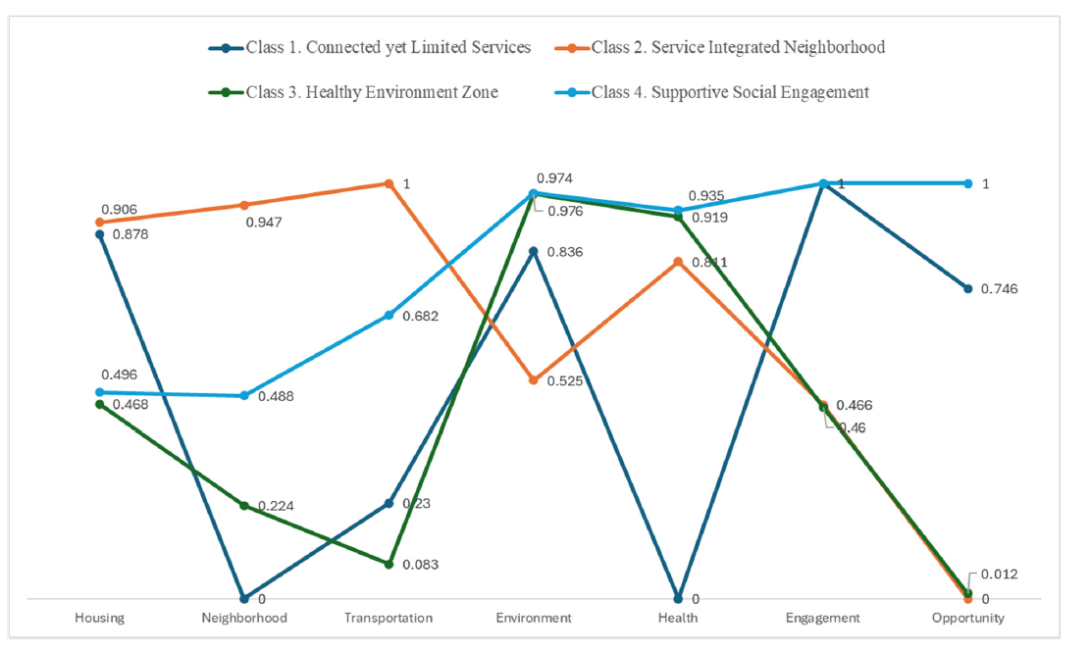
Employing latent class analysis, we identified a four-class model of neighborhood types: “Connected yet Limited Services”, “Service Integrated”, “Healthy Environment Zones”, and “Supportive Social Engagement”. Older adults in “connected yet limited services” and “service-integrated” neighborhoods had worse self-rated health than those in “supportive social engagement” neighborhoods, especially among those who reported functional limitations. Our findings indicate that older adults with functional limitations particularly benefit from neighborhoods with robust health support and social engagement opportunities, highlighting the importance of designing inclusive and adaptable age-friendly environments to address diverse and changing needs.