


Great Lakes Data Centers: FAQs
GLDC HomeAnswers to commonly asked questions about data centers in the Great Lakes.
General
- Are data centers good or bad?
Data centers are neither inherently good nor bad.
They generate large capital investments, support digital services, and create stable tax bases when tax rates are designed properly. However, they are extremely energy-intensive, generate limited long-term employment, and can strain power, water, and land-use systems. The net outcome depends on how well growth is planned, regulated, and integrated into regional infrastructure strategies.
- Why are there so many data centers in Virginia? And the Great Lakes region?
Virginia became an early hub due to dense fiber networks, favorable regulation, and proximity to federal and corporate users. The Great Lakes region now attracts data centers because of available land, strong transmission infrastructure, cooler climates, and access to large metropolitan markets. Together, the Great Lakes states now host about one-fifth of U.S. data centers.
- Are all data centers the same?
- Image
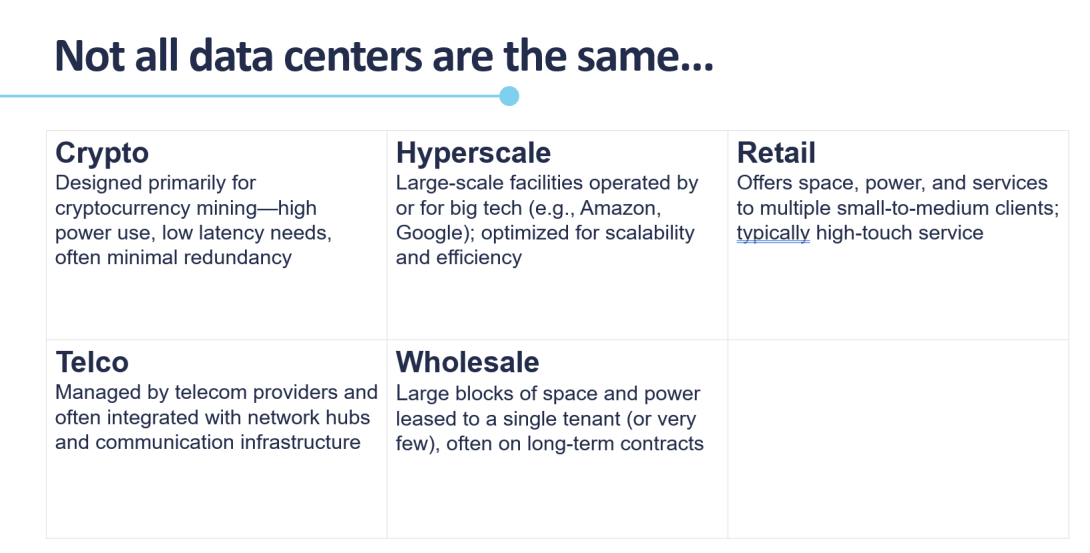
No. Data centers differ widely by type, size, and purpose.
Hyperscale and wholesale facilities are much larger and more energy-intensive than retail or telecom centers. Treating them as a single industry can mislead policymakers. Impacts on energy demand, employment, land use, and taxes vary dramatically by data center type.
- Will rural areas benefit from data centers?
In most cases, no. Data centers overwhelmingly locate in or near large metropolitan areas due to grid access, fiber connectivity, and latency requirements. In the Great Lakes region, over 95% of facilities are in medium or large metro counties. Rural benefits may occur, but they are typically indirect, through supply chains, rather than direct siting. Nevertheless, if a data center is located in a rural region, and even if that happens sporadically, that can be a game-changer if the right amount of benefits is captured by the local community.
- What role does AI play in data center growth?
AI is a major driver of recent expansion. Training and running large AI models requires enormous computing power, increasing both facility size and electricity demand. AI-focused data centers tend to operate at higher utilization levels and closer to maximum capacity, intensifying energy and infrastructure pressures.
- What should policymakers prioritize going forward?
Policymakers should focus on coordinated energy planning, transparent incentive frameworks, realistic employment expectations, and improved data transparency about resource needs early in the development process. Aligning data center growth with long-term energy, environmental, quality of life, and fiscal goals is essential to ensure benefits outweigh costs at the local, state, and regional levels.
Energy/Natural Resources
- What are some environmental impacts of data centers?
Data centers have several environmental impacts, largely linked to their scale and energy intensity. As electricity demand from data centers grows, reliance on fossil fuels may increase if renewable generation and grid upgrades do not expand at the same pace, potentially raising carbon-based emissions. Some data centers also consume water directly for cooling, especially those using evaporative or hybrid systems rather than air cooling. In addition, data centers indirectly consume water through electricity generation, since power production is itself water-intensive. Other localized impacts can include wastewater discharge and noise from cooling equipment and backup generators, particularly in dense urban settings. Besides this, the massive production of chips and IT material is by itself a source of environmental impacts but that was not covered in this study.
- What is the link between data centers and electricity demand?
Data centers are among the fastest-growing sources of electricity demand. Modern facilities, especially hyperscale and AI-oriented centers, consume 10 to 40 times more power than older facilities. In the Great Lakes region, data center electricity demand is projected to rise rapidly, potentially representing almost 10% of total state electricity demand by 2030.
- Do data centers affect water resources?
Yes, directly and indirectly.
Some data centers use large volumes of water for cooling, especially during peak demand periods when temperatures are warmer, which can also coincide with periods of potential water scarcity. In addition, water is needed to generate the electricity they consume. The amount of water needed depends on the source of the electricity, with coal and nuclear requiring more water, natural gas requiring less, and solar and wind requiring none. While water impacts vary by cooling technology and energy mix, large clusters of data centers can create localized water-management challenges.
- Are data centers energy-efficient?
Data centers have become more efficient at the facility level, measured by improvements in Power Usage Effectiveness (PUE). However, efficiency gains are being overwhelmed by rapid increases in computing demand, especially from AI workloads. As a result, total energy consumption continues to rise sharply despite technological improvements.
- How important is energy planning for data center growth?
Energy planning is critical. Data centers can be built in 18–24 months, while grid upgrades often take a decade or more. Without coordinated planning, growth can strain system reliability, delay interconnections for other users, and increase costs. States with rapid development face urgent needs for transmission planning, generation coordination, and demand forecasting.
Economic/Fiscal
- Should data centers be treated as a single economic sector?
No. Data centers span multiple industries, including real estate, the health industry, cloud services, telecommunications, and high-performance computing. Using a single industrial classification obscures differences in supply chains, labor needs, and fiscal impacts. Policymaking and economic analysis benefit from treating data centers as a composite infrastructure sector.
- Who owns data centers, and why does it matter?
Most large data centers are owned by out-of-state or multinational firms. In-state ownership is common only among older, smaller retail facilities. Ownership matters because profits, decision-making, and reinvestment often flow elsewhere, meaning local benefits depend largely on tax policy, infrastructure agreements, and procurement rather than corporate headquarters.
- How many jobs does a data center create?
Employment impacts vary widely by facility size, technology, business model, and operator. In general, modern data centers are highly capital-intensive rather than labor-intensive. Most jobs are created during the construction phase, which is temporary. Once operational, a large data center typically supports only a small permanent workforce. Industry and academic studies commonly find employment ratios on the order of one direct permanent job per roughly 5,000–10,000 square feet of operational data center space, with hyperscale and crypto facilities often at the lower end of job intensity. As a result, long-term employment impacts are modest relative to investment size.
- How predictable is future data center demand?
There is uncertainty. While growth is driven by AI, cloud services, and digitalization, demand depends on technological change, energy prices, and regulatory constraints. Overbuilding risks exist if projections prove optimistic. Regular assessment of market conditions and adaptive planning by data center developers are essential to avoid stranded infrastructure or excess capacity.
- Do data centers generate significant tax revenue?
Yes, but outcomes vary widely. Data centers generate taxable activity through construction, energy purchases, and property taxes. However, extensive tax incentives can significantly reduce net fiscal benefits. States with large pipelines of projects can see meaningful revenues, but only if incentive structures are transparent, limited in duration, and aligned with long-term costs.
- Can states compete for data centers without harming public finances?
Only with coordination and restraint. Aggressive tax competition can erode public revenues without changing where facilities locate, especially when decisions are driven by grid capacity and network access. Transparent incentives tied to performance, energy efficiency, or infrastructure contributions reduce the risk of a race to the bottom.